
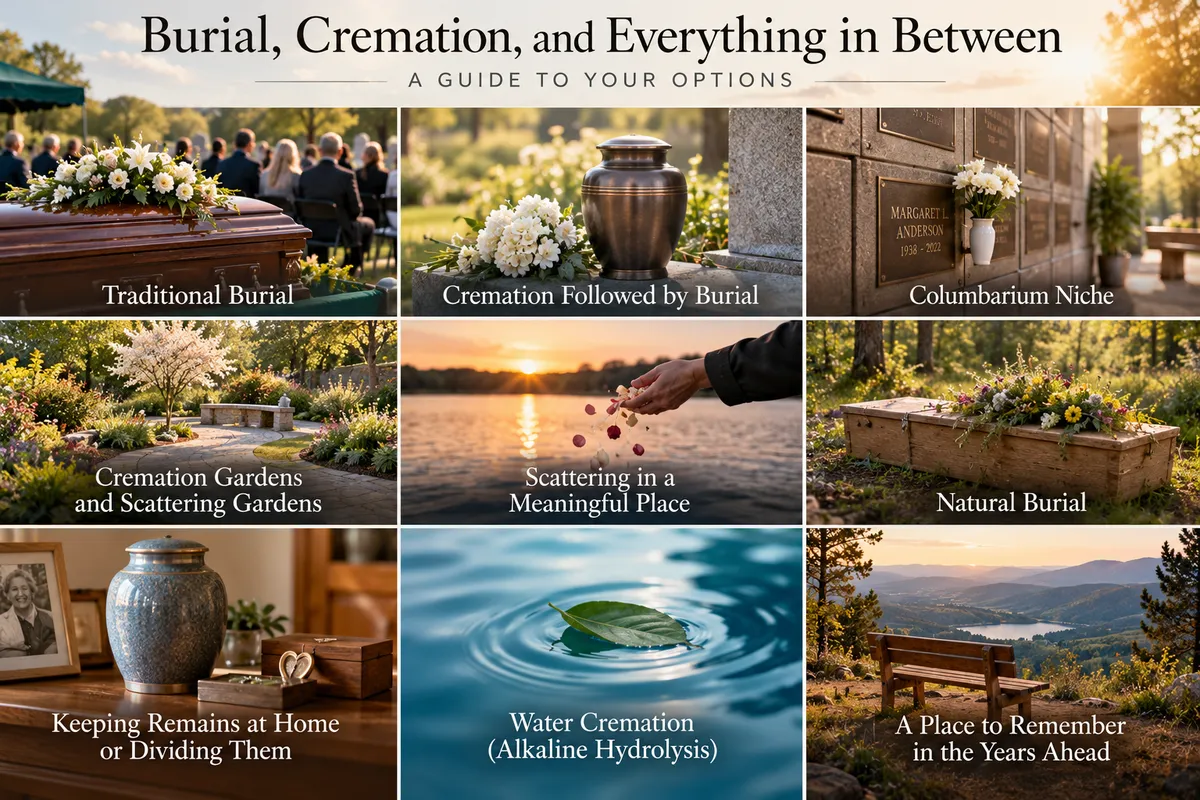
Burial, Cremation, and Everything in Between
In the first conversation with a funeral home, families often ask one question before any other. "Burial or cremation?" Once they have answered it, many assume the hard part is over. If the answer is cremation, some assume there is nothing else to decide.
That assumption leaves a lot on the table. Burial or cremation is a decision about what happens to the body. It is not a decision about how the family gathers, how they say goodbye, or where people will go to remember. Those are separate choices, and each one is still open no matter which way the first question is answered.
A family who chooses cremation can still hold a gathering, a ceremony with a Celebrant, and a reception. A family who chooses burial can still have a farewell that looks nothing like a traditional funeral. With that settled, here is an overview of the most common options.
Traditional burial
The person is placed in a casket and buried in a cemetery plot, usually after a ceremony at a funeral home, place of worship, or the graveside. Many cemeteries require an outer burial container, sometimes called a vault or grave liner, to keep the ground from settling. A headstone or marker is typically placed later. Traditional burial gives the family a permanent place to visit and is central to many faith traditions.
Cremation followed by burial
After cremation, the remains can be buried in a cemetery plot, often a smaller one than a casket requires. Some cemeteries allow cremated remains to be placed in an existing family plot, which can mean husband and wife rest together even if one was buried and the other cremated. Rules vary by cemetery, so it is worth asking.
Columbarium niche
A columbarium is a structure with small compartments, called niches, designed to hold urns. Columbaria can be found in cemeteries, churches, and memorial gardens, indoors or out. A niche provides a permanent place with a name plate, and it is often less expensive than a burial plot.
Cremation gardens and scattering gardens
Many cemeteries now have gardens set aside specifically for cremated remains, where they can be buried or scattered in a landscaped setting. These often include a shared memorial wall or individual markers, so the family has a place to visit even when the remains are scattered.
Scattering in a meaningful place
Scattering remains in a place the person loved, such as a lake, a mountain, a golf course, or the family farm, is a choice many families find deeply meaningful. It is also governed by rules. Private land generally requires the owner's permission. Parks and public lands have their own regulations, which vary by state and agency. Scattering at sea is regulated by federal rules that require it to take place at least three nautical miles from shore, with a report to the Environmental Protection Agency afterward. Your funeral team can help you understand what is permitted where you want to go.
Natural burial
Natural or green burial places the body in the ground without embalming, in a simple biodegradable casket or shroud, often in a cemetery or conservation area where the land is preserved. It appeals to families who want a farewell that returns the person to the earth as simply as possible. Availability varies by region.
Keeping remains at home or dividing them
Some families keep an urn at home. Others divide the remains among family members using small keepsake urns or memorial jewelry, or combine a portion kept at home with a portion buried or scattered. This can resolve disagreements when family members live far apart or feel differently about what should happen.
Water cremation
Alkaline hydrolysis, often called water cremation, uses water and an alkaline solution rather than flame. It is legal in a growing number of states but not in all. If it interests you, ask whether it is available in your area.
Questions worth asking
Before deciding, a few questions can help. Did the person express a wish, and how strongly? Does their faith tradition have expectations? Where will people go to remember them in five years, or twenty-five? Is there a family plot, or a place that mattered to them? What fits the budget without leaving the family feeling they cut corners?
There is no single right answer. There is only the answer that fits this person and this family.
Where the team fits in
Most people make this decision only a few times in their lives, often under pressure, and with incomplete information. A funeral team makes it with families every day. They know the local cemeteries, the rules for scattering in your state, what columbaria are nearby, and what each option realistically costs. Their job is not to steer you. It is to make sure you understand your choices well enough to make one you will not second-guess later.
Your next step
Ask the funeral team in your area which of these options are available nearby, what the local rules are, and what each one costs.